
Report of the President of the Federation of Icelandic Artists
for the Operating Year 2025–2026
Presented at the Annual General Meeting, 22 March 2026
The Board of the Federation of Icelandic Artists consists of the chairpersons of its sixteen member associations. The President of the Federation is Jóna Hlíf Halldórsdóttir, who was elected for a two-year term in 2024.
During the year, the board allocated responsibilities as follows: Margrét Tryggvadóttir, Chair of the Writers’ Union of Iceland, served as Secretary, and Gunnar Hrafnsson, Chair of the Icelandic Musicians’ Union (FÍH), served as Treasurer. The Financial Director of FÍH, Lúðvík Júlíusson, is responsible for the federation’s bookkeeping and the submission of accounts to the accountant, Helga Þorsteinsdóttir. The auditors for 2025 were Ragnheiður Tryggvadóttir and Guðmundur Helgason. The President of the Federation represents the organisation on the Nordic Artists’ Council (Nordisk Kunstnerråd) and also serves as the Council’s representative on the board of Circolo Scandinavo.
Introduction
The 2025–2026 operating year of the Federation of Icelandic Artists (BÍL) has been eventful and characterised by a wide range of initiatives relating to the position of artists and culture in society. This report outlines the main issues addressed by the board during the year, both in dialogue with government authorities, municipalities and other partners.
The board met eleven times during the year. Eight formal board meetings were held, in addition to a preparatory meeting concerning the federation’s centenary in 2028, chaired by cultural producer Ragnheiður Maísól Sturludóttir. During the year, the Board also held consultation meetings with the board of the Artists’ Salary Fund, the Icelandic Centre for Research (Rannís), and staff at the Ministry of Culture, as well as three working meetings with Logi Einarsson, Minister of Culture, Innovation and Higher Education. The Board also met with, among others, Heiða Björg Hilmisdóttir, Mayor of Reykjavík, representatives of Statistics Iceland, Kristín Eysteinsdóttir, Rector of the Iceland University of the Arts, and representatives of the Federation of University Graduates (BHM) and Viska.
Significant work lies ahead for the board in light of the upcoming municipal elections. In the coming months, BÍL will place particular emphasis on ensuring that cultural issues are included in the election agenda. To that end, questionnaires will be sent to candidates in municipalities that operate cultural institutions or support cultural activities, with the aim of gaining a clearer understanding of their policies and future vision in the field of culture.
We live in a time of considerable uncertainty, where the global landscape has changed rapidly and continues to change almost daily. Armed conflict, the spread of disinformation and climate change affect societies worldwide and shape public discourse and political life. In such times, the role of art and culture becomes even more important. Artistic expression and culture are fundamental elements of an open and democratic society, where freedom of expression is respected and cultural heritage, including the Icelandic language, is preserved, cultivated and developed.
- Meetings with Logi Einarsson, Minister of Culture, Innovation and Higher Education
During the year, the board of BÍL held three working meetings with Logi Einarsson, Minister of Culture, Innovation and Higher Education, as well as one meeting with ministry staff. These meetings provided an important forum for discussing the position of arts and culture and the key challenges in artists’ working environment. The board emphasised the importance of regular consultation with the Minister, as many urgent issues require ongoing dialogue and cooperation.
However, organising the meetings proved challenging, and it was often difficult to secure meeting times. Some meetings were also short, and it was not possible to address all the issues the federation had put forward for discussion. The final meeting of the year was however extended, allowing for more in-depth discussion of matters concerning artists.
Among the main topics discussed was the planned restructuring of cultural funds and the possible consolidation or coordination of their administration. It was emphasised that such changes must ensure the continued presence of professional expertise within individual art forms, and that any efficiency gains should be returned to the funds and ultimately to artists. The board also stressed that even if administration were to be centralised within a shared system at Rannís, services should remain with the cultural centres. Such coordination could reduce administrative burdens and create more room for other tasks that have been delayed due to staff shortages.
The meetings also included detailed discussion of the system of artists’ salaries and the importance of strengthening it. The board emphasised that artists’ salaries constitute one of the most important foundations for independent artistic creation in Iceland and that it is necessary to increase them so that they better reflect the actual cost of living and wage development in the country. The need to improve the overall working environment for self-employed artists was also discussed.
In this context, BÍL has pointed to the need for systems that can support artists between projects, for example drawing on the so-called Alliance model used abroad. The federation has also emphasised the importance of considering the introduction of chain responsibility in cultural activities, ensuring that public funding and grants guarantee that artists’ wages and working conditions meet reasonable standards.
The meetings also addressed the position of cultural funds and the need to strengthen them through increased investment. The board stressed that cultural funds are key infrastructure in Icelandic cultural life and that funding for many of them is insufficient to meet demand. Success rates for applications are often very low, meaning that many professionally strong projects do not receive support.
Music Fund
It was pointed out in the meetings that the Music Fund plays a key role in promoting diversity and quality in Icelandic musical life. In the most recent allocation, the success rate of applications was only 11%, meaning that most professionally strong projects receive no support. The reduction in the fund’s budget between 2025 and 2026 amounts to 3.46%. BÍL considers it necessary that the contribution to the fund be corrected and amount to at least ISK 235 million, indexed to wage developments.
Film Fund
The position of the Icelandic Film Fund was also discussed. The fund supports Icelandic filmmaking and the development of film culture. Support from the fund is often a prerequisite for attracting other investors and international co-producers to projects. Despite the government’s film policy extending to 2030, the position of the fund is a matter of concern, as unchanged allocations effectively constitute a reduction. BÍL considers it necessary that the contribution to the fund amounts to at least ISK 1,650 million and that ISK 400 million be added to the television fund in order to follow up on the policy’s action plan.
Authors’ Public Lending Right Fund
The meetings also addressed the position of the Authors’ Public Lending Right Fund, which pays authors and translators remuneration for the lending of books in libraries. The fund was increased in 2021 following an agreement on payments related to lending from the Icelandic Audio Library, but since then a reduction of approximately 22.8% has been proposed in the national budget. This reduction particularly affects authors of children’s books, translators and authors of popular fiction. BÍL considers it important to correct the fund’s allocation so that it reflects wage developments, although some adjustment was made when the budget was adopted.
Performing Arts Fund
The board also drew attention to the position of the Performing Arts Fund, which supports professional theatre companies and independent performing artists. In the most recent allocation round, 115 applications were submitted, requesting over ISK 1.6 billion, while total support amounted to only ISK 155 million. The success rate was therefore just 9.68%, which is far below what is considered normal in comparable funds. The federation considers it necessary that the contribution to the fund be at least ISK 320 million.
Visual Arts Fund
The position of the Visual Arts Fund was also discussed. The fund was established in 2013 to support Icelandic visual art through financial assistance to artists and institutions. In 2025, 423 applications were submitted, but only 109 projects received funding. The total amount requested was ISK 475.8 million, while the total allocation was only ISK 64 million, corresponding to a success rate of 14%. The federation considers it necessary that the fund’s allocation be adjusted in line with the objectives of the national visual arts policy.
Children’s Culture Fund of Iceland
Finally, the importance of the Children’s Culture Fund of Iceland was discussed. The fund supports the participation of children and young people in culture and the arts across the country. BÍL considers it important that the fund’s allocation be adjusted to ISK 120 million in accordance with the government’s action plan.
In the federation’s view, it is important to establish regular consultation with the Minister in order to work systematically towards improving artists’ working conditions. Significant work lies ahead to ensure that artistic disciplines can thrive, that artists have viable employment opportunities within their fields, are paid for their work, and receive fair remuneration in line with general wage developments in the country.
- Consultation Meeting with Heiða Björg Hilmisdóttir, Mayor of Reykjavík
On 14 January 2026, the board of BÍL held a consultation meeting with Heiða Björg Hilmisdóttir, Mayor of Reykjavík. The meeting was held based on a cooperation agreement between the federation and the City of Reykjavík, under which BÍL provides professional advice on arts and cultural matters with the aim of strengthening professionalism in the city’s cultural activities.
A wide range of issues relating to the position of artists and cultural activities in Reykjavík were discussed at the meeting. Among the main topics were housing for artists and the lack of cultural spaces in the city. BÍL called for targeted measures to ensure space for artistic creation, rehearsals, concerts and exhibitions, and emphasised the importance of protecting smaller music venues and grassroots initiatives, which have been under pressure in recent years.
The meeting also addressed the cultural policy of the City of Reykjavík and the need for a new action plan. The federation highlighted the importance of the city’s cultural grants and proposed that the funding scheme be strengthened, and its structure reviewed in order to increase transparency and professionalism in allocation decisions. The position of music schools in Reykjavík was also discussed, with concerns expressed about budget cuts and age restrictions imposed on students.
In addition, the future of Korpúlfsstaðir as a centre for artistic creation was discussed, as well as the position of SÍM’s international residency programme, the strengthening of the UNESCO City of Literature initiative and the Reykjavík City Library’s literary web platform, school libraries in the city’s compulsory schools, and the development of Reykjavík’s policy on the use of artificial intelligence in administration.
The meeting was constructive and substantive. The Mayor was well prepared, responded positively to the views and proposals presented by the federation’s representatives, and engaged in a constructive dialogue on the current status and future of cultural affairs in the city.
- Artists’ Salaries
During the year, the board of BÍL worked to raise awareness among government authorities and the public about the status of artists’ salaries and the extent to which they have fallen behind general wage developments. Artists’ salaries were discussed at all meetings between the board and Logi Einarsson, Minister of Culture, Innovation and Higher Education, where the importance of revising salary levels in accordance with legal provisions was emphasised.
On 13 January, an article by the president of BÍL was published on Vísir under the title What is the value of the working environment of visual artists?, addressing the status of artists’ salaries and the importance of increasing monthly payments. The article pointed out that artists’ salaries have not kept pace with general wage developments since the current system came into effect.
In 2026, artists’ salaries amount to ISK 580,000 per month as contractor payments, which corresponds to approximately ISK 390,000 in wages. Had salaries followed general wage developments, they would amount to approximately ISK 770,000 per month in 2026. Article 4 of the Act on Artists’ Salaries states that the amount of the artist’s salary shall be reviewed annually in connection with the state budget, taking into account developments in wages, prices and economic conditions.
On 1 December 2025, artists’ salaries for 2026 were allocated, and artists were informed of changes in the accounting treatment of payments. In recent years, artists’ salaries had been recorded as grants by the Financial Management Authority, but going forward they will be defined and recorded as contractor payments in accordance with the law.
According to regulations, artists’ salaries are defined as equivalent to 66% employment, and recipients are not permitted to undertake paid work exceeding 33% employment while receiving such salaries. Artists are therefore subject to restrictions on their ability to earn additional income. In practice, this can result in periods during the year where artists have no income or earn below minimum wage during the months when they receive salaries.
The board considers it important that the state adjust the level of artists’ salaries in line with wage developments in the country and add 35% on top of that amount to cover social security contributions and other payroll-related costs. In the board’s view, artists’ salaries should amount to ISK 1,039,500 per month as contractor payments, which would align with the salaries and wage development of public sector employees.
Artists’ salaries have been, and continue to be, one of the most important foundations of arts and culture in Iceland. They support creative work in the country and the societal benefits that result from it. These salaries are therefore not only support for individual artists, but an investment in culture and the intellectual life of the nation.
- Establishment of an Opera
An important milestone in Icelandic cultural life was reached when Alþingi approved, on 13 June 2025, a bill on the establishment of an opera. With the adoption of the legislation, opera as an art form is ensured a position comparable to other performing arts in the country, and a stable and professional foundation is created for opera activity in Iceland.
BÍL participated in the preparatory work that led to the legislation, and the board welcomed the outcome as an important step forward for the performing arts and musical life in the country. The aim of the legislation is to strengthen opera as a fundamental pillar of Icelandic cultural life and to create a stable working environment for the art form, as well as to ensure broader public access to opera throughout the country.
To mark this milestone, the board hosted a celebratory event at Hotel Holt on 4 September 2025. Artists and others who had contributed to the preparation and development of the initiative over recent years attended the event, including representatives of working groups and artists who had worked systematically towards the establishment of an opera.
According to the legislation, opera activity will be operated as part of the National Theatre of Iceland and will be primarily based at Harpa Concert Hall. This arrangement is intended to ensure a strong professional environment for the activity and to utilise the infrastructure and support services of the National Theatre. On 11 January 2026, Finnur Bjarnason was appointed Opera Director for a five-year term and will lead the development and operation of the opera in the coming years.
- Wage Developments at the Iceland University of the Arts
During the year, the board of the federation focused on the wages of artists working at the Iceland University of the Arts (IUA), which is one of the largest workplaces for artists in Iceland. On 26 May 2025, the board sent a letter to Kristín Eysteinsdóttir, rector of the IUA, requesting information on wage developments among the University’s staff over the past five years. The request was for aggregated data, without personal information, on wages and wage developments across different staff groups, including permanent faculty, adjunct teachers, administrative staff and workshop staff, as well as information on the number of employees in each category.
The aim of the request was to obtain data that could shed light on the position of artists working at the University and support informed discussion about their working conditions.
Following this request, the board was invited to a meeting with the University’s management on 7 November 2025, where wage developments and working conditions were discussed. It was noted at the meeting that the IUA is the second largest employer of artists in Iceland, after the artists’ salary system, and that it is important to collect data on wages in order to assess the position of artists working at the institution. Representatives of the University presented the basis for wage determination. It was noted that the IUA is not a party to a collective agreement but uses the agreements between the Confederation of Icelandic Enterprise and the Federation of University Graduates as a reference for academic staff. The University’s wage policy is based, among other things, on job classification, human resources policy and equal pay certification, and according to University management, its equal pay analysis has yielded positive results from the outset.
It was also noted that the wages of academic staff at the IUA are primarily based on criteria related to university teaching rather than specifically on work in the arts and creative fields. At the meeting, the results of an analysis of wages and wage developments among different staff groups from 2020 to 2025 were presented. These included, among others, teaching staff with an artistic background, support staff, workshop staff and managers. According to the presentation, the average wages of staff with an artistic background, both teachers and managers, were higher than those of other staff groups within the University. However, no detailed wage figures were provided, except for hourly rates for adjunct teachers.
Furthermore, it was noted that the wages of adjunct teachers had increased by 22.5% over the period and that their hourly rate was comparable to that at the University of Iceland. Adjunct teachers may choose whether to work as employees or independent contractors, but contractor payments include a 17.85% surcharge to cover pension contributions and social security costs.
Following the meeting, the board held a consultation meeting with representatives of Viska, where the situation was reviewed and next steps discussed. Concerns were raised about the position of adjunct teachers, including the extent of preparation work that is not always remunerated, and it was noted that contractor payments do not fully reflect the costs associated with such arrangements. Issues relating to the duration of academic appointments, staff turnover and the need for further data on wages and wage developments at the University were also discussed. Representatives of Viska will continue to work on data collection and analysis, and further consultation with the University’s management is planned once the results are available.
- Wage Developments of Visual Artists in Public Art Museums and Artist-Run or Union-owned Museums
During the year, the Association of Icelandic Visual Artists (SÍM) led a project analysing wage developments for visual artists in public art museums in Iceland. BÍL and the visual artists’ network within Viska contributed to the project and provided advisory support. At the initiative of SÍM, information was requested from museums regarding payments to visual artists over the past three years.
The results demonstrated a clear need to review the situation. It emerged that some museums had not updated their rates in accordance with established guidelines, which stipulate that payments should follow the rates set by SÍM. Examples include the Gerðarsafn Art Museum, Hafnarborg and the Akureyri Art Museum, which had not updated payments since the introduction of the guidelines. In some cases, museums had paid as little as ISK 6,000 per hour, which is approximately half of the current rate set by SÍM. It also emerged that some museums had imposed caps on artists’ working hours, in some cases limiting payment to eight hours regardless of the actual scope of the work.
The analysis also showed that the hourly rates of visual artists are generally lower than those of comparable professional groups within the creative sector. The hourly rate according to the association’s 2026 tariff is ISK 12,882 per hour as contractor payment. By comparison, the hourly rate of music teachers according to FÍT is approximately ISK 17,744, the hourly rate of actors under contracts with the National Broadcasting Service (RÚV) can be around ISK 20,636 (based on actors with average experience), and the hourly rate of architects according to the Association of Icelandic Architects is approximately ISK 25,000 per hour.
The next steps in this work lie with SÍM in cooperation with BÍL and other stakeholders. Museums that do not have sufficient funding to pay according to the guidelines must seek increased funding from their owners. The goal is that all public art museums in Iceland will pay artists according to the SÍM’s rates no later than 2027.
- Iceland’s Industrial Policy to 2035
On 26 August 2025, the board of BÍL submitted a formal opinion to the government consultation portal regarding the proposed industrial policy of Iceland to 2035. In its submission, the board welcomed the government’s decision to develop a comprehensive long-term industrial policy but emphasised the importance of recognising arts and culture as an independent and growing sector within the Icelandic economy.
The submission highlighted that culture, and the creative industries are not only important for social wellbeing but also represent a genuine economic driving force. Reference was made to the report The Contribution of Culture and Creative Industries to Value Creation in Iceland, prepared for the Ministry of Culture and Business Affairs, which found that the direct contribution of culture and creative industries to GDP amounted to 3.5%, or approximately ISK 150 billion, in 2022. In the federation’s view, national industrial policy should reflect the fact that the arts and culture are economic sectors on a par with others and have both economic and social value.
The board also emphasised that investment in the arts and creative industries is one of the most effective ways to promote long-term value creation. In this context, it highlighted the importance of strengthening cultural centres such as the Icelandic Literature Center, the Icelandic Film Centre, the Performing Arts Centre of Iceland, the Visual Arts Centre, the Music Information Centre and the Centre for Design and Architecture, as well as strengthening artists’ salary funds. Such measures support innovation, increase export opportunities for Icelandic art and create international value that ultimately returns many times over to society.
The submission also noted that the creative industries have significant growth potential and that their environmental impact is generally limited. At the same time, BÍL considers that both the state and municipalities face an infrastructure deficit in relation to the arts and creative industries. For these sectors to thrive, artists must have access to space, time and investment for creative work. Such investment yields significant returns for society, both economically and culturally.
The federation followed up on its submission at a meeting with Logi Einarsson on 13 March 2026, where the role of the arts and creative industries in the future industrial policy was discussed. BÍL hopes to participate in the continued development of the policy.
- Statistics Iceland
In February 2026, BÍL representatives met with Statistics Iceland regarding cooperation between the parties based on a collaboration agreement from 2022. The agreement is important for the federation as it provides a foundation for the compilation of statistical data on the working conditions and circumstances of artists in Iceland. At the meeting, the procedures for data submission were reviewed, and it was agreed that the federation would submit the national identification numbers of its members in CSV format for the period 2025–2026 for processing by Statistics Iceland.
Further cooperation is planned regarding the processing and analysis of data, with BÍL intending to involve the Federation of University Graduates (BHM), Viska and the Research Centre for the Creative Industries. The aim is to establish a comprehensive survey mapping the economic situation, working conditions and living standards of artists, including analysis of income, employment patterns and social conditions. There was also a discussion of the examination of artists’ pension rights, which could provide a clearer insight into the situation highlighted by the federation, namely that the living conditions of many artists are insecure and below average. Comparable studies have been conducted abroad, and such surveys can have significant impact on cultural policy development and public discussion on artists’ conditions. Further meetings with Statistics Iceland are planned during the year in order to advance the project.
- BÍL’s Inclusion Policy
At BÍL’s annual General Meeting on 16 March 2024, a draft inclusion policy was presented, developed by Eva Signý Berger and Lilja Björk Haraldsdóttir. Work on the policy continued during the operating year in consultation with additional advisors and stakeholders, and it is now ready for adoption. It is intended that the policy will be submitted for approval at BÍL’s annual General Meeting held today, 22 March 2026.
The purpose of the policy is to promote increased accessibility, equality and inclusion within Icelandic cultural life. The federation emphasises that a cultural sector that does not reflect the diversity of society cannot be considered a fully democratic space, and that it is important to identify and remove systemic barriers that may limit participation in artistic and cultural activities.
The policy focuses on three main areas. First, that BÍL’s nominations to committees, councils and boards reflect the diversity of Icelandic cultural life and promote equality in decision-making. Second, that the federation’s working practices are based on transparency, accessibility and inclusion, ensuring that information, opportunities and participation are accessible to all. Third, that the federation uses its influence in cultural policy to promote greater equality and diversity within Icelandic cultural life.
To implement the policy, BÍL has also developed a three-year action plan. This includes, among other things, the development of indicators to assess accessibility and diversity in nominations, the establishment of an advisory group on inclusion and accessibility, and the implementation of procedures ensuring that inclusion and equality are guiding principles in the federation’s activities.
With this policy, BÍL commits to working systematically to increase access to opportunities and influence within the cultural sector and to ensure that Icelandic cultural life more clearly reflects the diversity of society.
- The Federation’s Recommendations on the Use of Artificial Intelligence
During the year, BÍL worked on the development of recommendations regarding the use of artificial intelligence in the creative industries. The recommendations are based on a model developed by the Swedish umbrella organisation KLYS – the Joint Voice of Sweden’s Professional Cultural Creators, which granted permission for the text to be translated and adapted to Icelandic conditions.
The board appointed a working group for the project, consisting of BÍL’s president, Hlynur Helgason, Gunnar Hrafnsson and Sveinbjörn Baldvinsson. Sveinbjörn Baldvinsson translated the original Swedish text, and the federation subsequently engaged Sigríður Hagalín Björnsdóttir to revise and adapt the text into clearer and more accessible Icelandic.
The recommendations are intended for government authorities, public institutions and companies that use artificial intelligence in the production or dissemination of content. Their purpose is to promote responsible use of artificial intelligence that respects artists’ copyright and safeguards the conditions for human creativity. Among other things, the recommendations emphasise respect for copyright, transparency in the use of artificial intelligence, and the importance of avoiding the use of such technologies in ways that undermine the work of professional authors and artists.
It was decided to publish the recommendations in two versions: a shorter version outlining the main principles in a concise manner, and a longer version providing more detailed guidance that institutions, companies and professional organisations can apply in their own activities. Plans are in place to commission Brandenburg Creative Agency to design a digital publication of the recommendations, which will be made available on BÍL’s website once the text has been finalised.
- The Status of Music Education in Iceland
In November 2025, BÍL issued a resolution on the status of music education in Iceland in collaboration with several professional associations and stakeholders in the fields of music and music education. The resolution was sent to government authorities, municipalities and educational institutions with the aim of drawing attention to developments in recent years indicating that the position of music education is weakening, both within music schools and in the general education system.
Among other things, the resolution calls on the government to begin work on a framework law on arts education in accordance with the national education policy to 2030, thereby ensuring a clear policy and equal access to music education. It also notes that the publication of a new national curriculum for music schools has been delayed and that this needs to be addressed.
The resolution also discusses the funding of music schools, pointing out that recent budget cuts have affected access to education and the availability of instruction. It highlights a shortage of music teachers and emphasises the importance of strengthening their education at the Iceland University of the Arts.
It is also noted that teaching in singing and music education in compulsory schools has declined in many areas. Stakeholders call for the revitalisation of music education as a core component of schooling and stress the importance of ensuring stronger foundations for music education at all levels of the education system.
The board of the federation will continue to advocate for improvements in these areas and will maintain pressure on both the City of Reykjavík and the state to take systematic action to strengthen music education and invest in a robust system of music schools throughout the country. Such investment is fundamental to the continued development of Icelandic musical life and represents an important contribution to culture, creativity and social well-being in the long term.
- International Cooperation
During the operating year, BÍL continued to place strong emphasis on active cooperation with its Nordic counterparts and participation in international forums concerning the status of artists and culture. Such cooperation is important for strengthening shared perspectives and addressing common challenges faced by artists across the Nordic region.
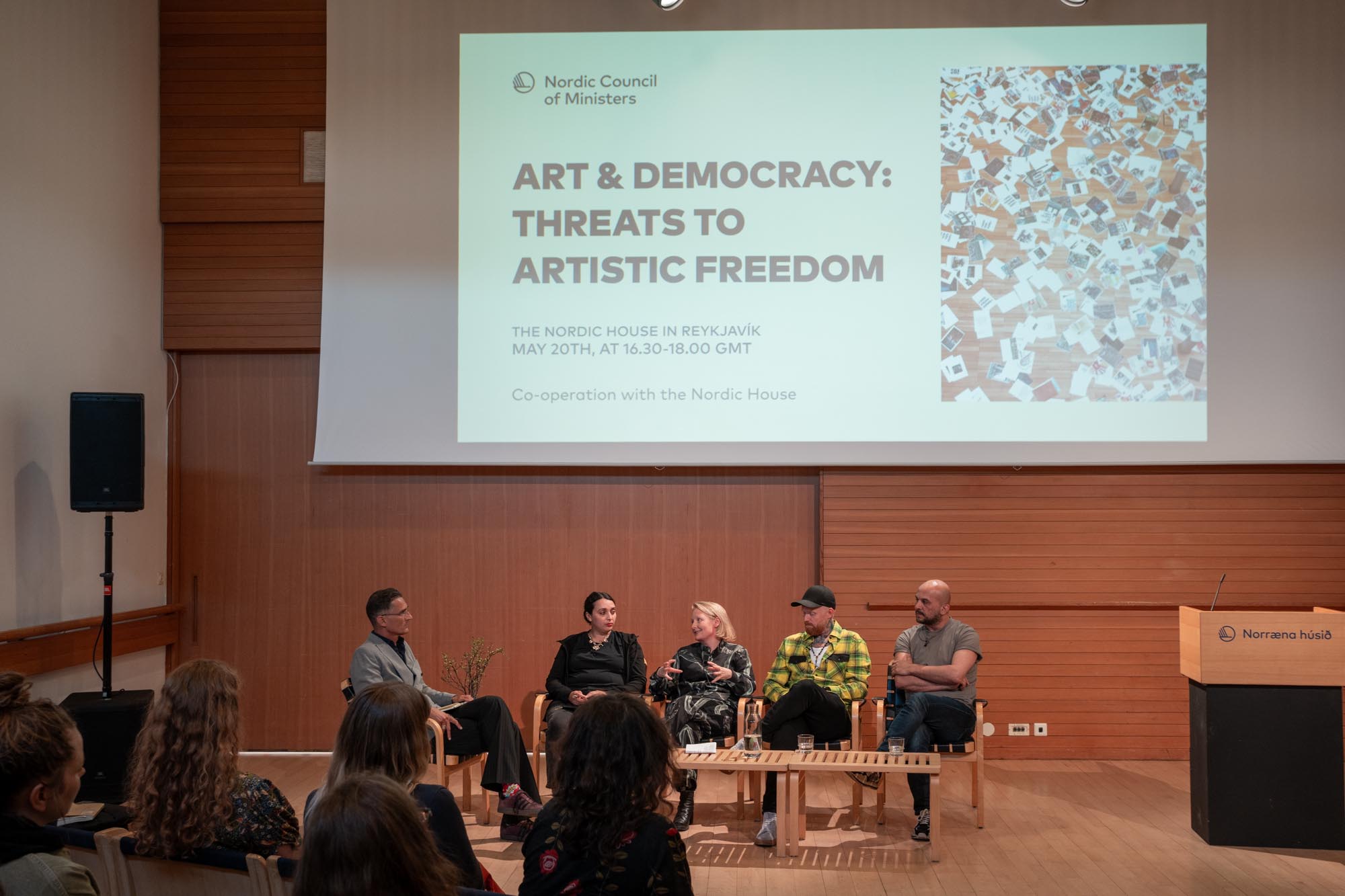
One of the Federation’s most important international collaborations is its participation in Nordisk Kulturråd, a cooperative platform for artists’ organisations from the Nordic countries. Representatives from Denmark, Finland, Iceland, Norway and Sweden participate, along with representatives from the Faroe Islands, Greenland and the Sámi Artists’ Council. The aim of the council is to strengthen cooperation among artists’ organisations in the Nordic region and to work jointly on issues relating to artists’ working conditions and cultural policy in an international context. The next meeting of the Council is planned for the end of April in Greenland, where representatives will discuss the position of artists and culture in a changing global environment.
In March 2026, the council issued a joint statement of support for artists in Greenland. The statement expressed strong solidarity with Greenlandic artists during a time of political uncertainty and increasing external pressure regarding the country’s future. It emphasised that artistic expression and culture are fundamental to self-determination, democracy and human dignity. It also highlighted that Greenlandic culture, language and artistic traditions are living expressions of a society that has the right to shape its own future. Nordic artists’ organisations further expressed their support for artistic freedom, freedom of expression, cultural autonomy and the right of artists to work without political pressure or external interference.
At a time when war, rising geopolitical tensions and authoritarian regimes threaten democratic values, cooperation among Nordic artists’ organisations has never been more important. Solidarity and dialogue across borders strengthen the voice of artists and create a platform for defending the values on which art and culture are built.
The president of BÍL serves on the board of Circolo Scandinavo on behalf of Nordisk Kulturråd. Circolo Scandinavo is a residency in Rome that has, for decades, provided an important platform for Nordic artists, offering opportunities to live and work on projects for up to three months at a time. In recent years, Circolo’s activities have undergone restructuring following the impact of the COVID-19 pandemic and budget reductions from the Nordic Council of Ministers. Efforts are underway to strengthen the organisation again, including the renewal of its website and other initiatives. The residency plays an important role in Nordic cultural cooperation, enabling artists from different countries to meet, build networks and develop new collaborative projects. The need for such dialogue and cooperation has rarely been greater than at present, when democratic values face challenges in many parts of the world.
The federation places great emphasis on maintaining strong and active dialogue with its Nordic counterparts. Through such cooperation, it is possible to work jointly on major shared issues, including copyright, the impact of artificial intelligence on the arts and culture, environmental issues, and the importance of safeguarding democratic values.
- Solidarity with Palestine – A Nation Against Genocide
During the operating year, BÍL also engaged with international human rights issues and participated in a broad coalition of organisations expressing solidarity with the Palestinian people. The federation took part in the organisation and support of a mass meeting held in Reykjavík, calling for an immediate ceasefire and action to halt violence and civilian casualties in Palestine. The meeting formed part of a wider movement of solidarity actions involving numerous trade unions, human rights organisations and civil society groups.
The event marked an important moment in Icelandic public discourse, as a large number of people gathered to express solidarity with civilians in Gaza and to call on authorities to take action to promote peace and respect for international law.
The federation emphasises that art and culture play an important role in safeguarding human rights, freedom and human dignity. When such fundamental principles are violated, it is important for artists and their organisations to speak out and participate in public debate.
- Preparatory Meeting for the Federation’s 100th Anniversary
On 31 October 2025, BÍL held a workshop at Hannesarholt to begin preparations for its 100th anniversary in 2028. The meeting was chaired by cultural producer Ragnheiður Maísól Sturludóttir, who also prepared a detailed report on its outcomes. Approximately twenty-two participants attended, including members of the federation’s board, representatives of member associations and artists. The aim of the meeting was to gather ideas and begin shaping a vision for the anniversary year.
Discussions highlighted BÍL’s important role as a unifying platform for artists across disciplines and as a collective advocacy body in relation to government authorities. The federation’s future vision was also discussed, including the importance of strengthening its infrastructure, for example through the appointment of an executive director and securing office facilities.
A wide range of ideas were proposed for events and projects during the anniversary year. These included a major joint celebration on 6 September 2028, bringing together all art forms in a diverse programme. Other ideas included conferences, publications and media outreach to highlight the Federation’s history and the importance of the arts for society. Emphasis was placed on broad collaboration among professional associations and cultural institutions and on ensuring that events would take place across the country.
The next steps involve further developing the ideas presented at the meeting and determining which projects will be implemented. Plans also include meetings with leaders of cultural institutions and applications for funding from the Ministry to support the preparation and implementation of anniversary projects.
- Conclusion
My second year as president of the Federation of Icelandic Artists has been both educational and eventful, with a range of engaging and challenging projects. One highlight of the year was the Nordiskt kulturforum conference, held on 17–18 June in Suomenlinna, Helsinki. As president of BÍL, I participated in a panel discussion on the working conditions of artists in the Nordic countries, alongside representatives from artists’ organisations across the region. The conference provided an opportunity to discuss shared challenges in cultural policy and to present the perspectives of Icelandic artists in a Nordic context.
During the year, BÍL’s president placed emphasis on the federation taking an active role in public debate on the position of artists and culture through opinion pieces and articles. Among other things, the federation responded to criticism from the Taxpayers’ Association regarding artists’ salaries, which was based on misleading and incorrect data. The response emphasised the importance of artists’ salaries as a foundation for sustainable artistic creation and as an investment in culture, democracy and societal development.
The president also authored an article addressing the lack of spaces for artistic creation in Reykjavík and the importance of ensuring access to studios, rehearsal spaces, concert venues and exhibition spaces. Such spaces are fundamental infrastructure for cultural life and a prerequisite for artists to develop their work. Another article focused on the working environment of visual artists and the systemic challenges many artists face, including insecure income, lack of support systems and limited funding. It emphasised the importance of investing in the arts as both an economic sector and a societal asset.
It is important that the president of the federation actively participates in public discourse on the position of artists and culture in society. Through such engagement, it is possible to influence the agenda, bring attention to artists’ issues and communicate important perspectives to both government authorities and the public. This is essential for strengthening the position of artists and ensuring that the arts and culture receive the place in society that they deserve.
I would like to thank the current board for their cooperation during the year.
Member Associations and Their Chairs
- The Icelandic Association of Architects (AÍ)
Chair: Sigríður Maack - The Icelandic Choreographers’ Association (DFÍ)
Chair: Katrín Gunnarsdóttir - The Icelandic Classical Singers’ Association (KLASSÍS)
Chair: Þóra Einarsdóttir - The Association of Icelandic Musicians (FÍH)
Chair: Gunnar Hrafnsson - The Association of Icelandic Artists in Performing Arts and Film (FÍL)
Chair: Birna Hafstein - The Icelandic Association of Professional Dancers (FÍLD)
Chair: Lilja Björk Haraldsdóttir - The Classical Division of the Association of Icelandic Musicians (FÍT)
Chair: Margrét Hrafnsdóttir - The Icelandic Filmmakers Association (FK)
Chair: Steingrímur Dúi Másson - The Icelandic Association of Set and Costume Designers (FLB)
Chair: Eva Signý Berger - The Icelandic Playwrights and Screenwriters Guild (FLH)
Chair: Sveinbjörn Baldvinsson - The Icelandic Directors Guild (FLÍ)
Chair: Ólafur Egill Egilsson - The Icelandic Composers and Lyricists Association (FTT)
Chair: Bragi Valdimar Skúlason - The Writers’ Union of Iceland (RSÍ)
Chair: Margrét Tryggvadóttir - The Association of Icelandic Visual Artists (SÍM)
Chair: Anna Eyjólfsdóttir - The Film Directors’ Association (SKL)
Chair: Hrönn Sveinsdóttir - The Icelandic Composers Society (TÍ)
Chair: Páll Ragnar Pálsson
BÍL Representatives in Committees and Councils 2025–2026
Reykjavík City – Culture and Sports Division
Observer: Jóna Hlíf Halldórsdóttir
Alternate: Anna Eyjólfsdóttir
Grant Committee – Culture, Sports and Leisure Council
Primary: Gunnar Andreas Kristinsson
Alternate: Sólveig Arnarsdóttir
Primary: Helga Óskarsdóttir
Alternate: Starkaður Sigurðarson
Primary: Jóna Hlíf Halldórsdóttir
Alternate: Bergur Ebbi Benediktsson
Primary: Hanna Björk Valsdóttir
Alternate: Steingrímur Dúi Másson
Film Council
Drífa Freyju-Ármannsdóttir
Alternate: Benedikt Erlingsson
Iceland Arts Festival Council
Jóna Hlíf Halldórsdóttir
Alternate: Margrét Örnólfsdóttir
Artists’ Salary Fund Board (2024–2027)
Kolbrún Ýr Einarsdóttir
Alternate: Erling Jóhannesson
Skaftfell Board
Anna Eyjólfsdóttir
Alternate: Jóna Hlíf Halldórsdóttir
Advisory Council – Promote Iceland (Arts and Creative Industries)
Jóna Hlíf Halldórsdóttir
Reykjavík Cultural Flag Initiative
Karen María Jónsdóttir
Art Without Borders
Margrét Pétursdóttir
Alternate: Jóna Hlíf Halldórsdóttir
Gljúfrasteinn Board
Hafliði Arngrímsson
Alternate: Jóna Hlíf Halldórsdóttir
Cultural Advisory Council – Sláturhúsið, Egilsstaðir
Wioleta Anna Ujazdowska
Parliamentary Honorary Salary Committee
Páll Baldvin Baldvinsson
Alternate: Þórunn Gréta Sigurðardóttir
Copyright Council (2025–2028)
Mikael Lind
Alternate: Margrét Tryggvadóttir
Capital Region Development Group
Jóna Hlíf Halldórsdóttir
Children’s Culture Centre
Felix Bergsson
Alternate: Sigyn Blöndal
Art for All Advisory Group
Felix Bergsson and Hildur Steinþórsdóttir
Austurbrú Cultural Advisory Council
Hlín Pétursdóttir Behrens
West Iceland Development Fund – Cultural Council
Eirún Sigurðardóttir
Sustainability Council Representative
Erling Jóhannesson
Alternate: Sigríður Rósa Bjarnadóttir
Kjarval Studio Selection Committee, Paris
Erling Klingenberg
Alternate: Bergrún Snæbjörnsdóttir
Guðjón Samúelsson Cultural Fund
Erling Jóhannesson
Working Group on Participation of Disabled People in Cultural Life and Art Creation
Helga Rakel Rafnsdóttir
Alternate: Þórður Högnason